
The Most Unique Hotels in the World (Seven We’ve Actually Slept In)
Most hotels are a nice room in a nice place. These seven are not. In each one the building, or the thing you actually sleep in, is the reason for the trip — we would have gone even if the beds had been ordinary.
We have stayed in all seven, across seven countries: a canvas cocoon in a park where the neighbors are leopards, a monastery from 1284 with a cave underneath it, a fortress two hours into the desert, fourteen villas you reach by driving through a river, eight antique houses that were taken apart and shipped here, a woven nest up a rainforest hillside, and one of the largest private islands in the Maldives.
There is no ranking — a nest and a monastery are not competing for the same trip. What all seven share is that they are genuinely inconvenient, because being this odd usually means being this far away. That part is in here too.


A canvas cocoon inside a leopard park: Wild Coast Tented Lodge, Sri Lanka
Wild Coast Tented Lodge sits inside Yala National Park in Sri Lanka, where thick jungle drops straight down to a wild shoreline. It is a six-and-a-half-hour drive from Colombo, the capital, and once you are there, there is no town to walk into.
“This is not one of those places where after a morning on the beach you stroll into town — here, your nearest neighbors are elephants, wild boar and leopards.
The buildings are shaped like massive boulders, wooden inside like an open-air tropical hut and clad outside in tiles that give them their rock surface. The rooms are called cocoons, which is exactly right. Roof and walls are canvas, so they are technically tents, but most of the structure is wood and glass. Ours had a copper bath tub, a quirky copper pipe sink, a suitcase that opened out as the minibar and a huge glass front onto a wooden deck — plus WiFi, air conditioning and a Sonos system. Nobody was roughing it.
Meals are included, and the cooking is close to southern Indian, kept mild for anyone who does not want heat. Book a cocoon with a plunge pool if you can, so you can watch animals while you cool off; it is the one thing we would change. And if you walk in the forest, actually watch for wild animals. We mean that literally.


A fortress two hours into the desert: Qasr Al Sarab, United Arab Emirates
The drive is half of it. The dunes grow the deeper you go — ankle-high ripples become 40-meter giants that dwarf the car — and at some point our driver mentioned, in passing, that we had turned onto the private road. Ten minutes later Qasr Al Sarab appeared through the heat shimmer, rising out of the Liwa Desert in the United Arab Emirates like a modern fortress, in soft beiges and taupes that seem to breathe with the shifting sand.
Our deluxe terrace room opened onto an infinity pool that appears to spill straight into the dunes. The silence takes adjusting to: no traffic, no hum, just wind moving sand and the occasional camel caravan in the distance.
Book the sunset camel trek — four other guests, and the best part is the tea break on top of a high dune — then dune bashing the next morning, a driver taking 40-meter sand faces at angles that defy reasonable physics. Take the motion-sickness pills if you are prone to it. Chris also talked me into climbing a dune at sunset, which looked far worse than it turned out to be.
The catch is that you eat every meal here. There are five restaurants; Al Falaj is the one to do, a section of desert turned into an elegant Bedouin camp each night, with a set menu of Arabic-inspired dishes and wine under a star-filled sky. Prices feel steep until you remember that every ingredient has travelled two hours through desert to reach your plate.


A monastery from 1284, with a cave underneath: The Augustine, Prague
Now for one that is not in a jungle or a desert. The Augustine takes up seven buildings in the streets between Prague Castle and Charles Bridge, in the Czech Republic, and the oldest part dates to 1284. It was an Augustinian monastery, it still has its own brewery, and the conversion kept as much of the original as it could.
The Refectory Bar is where the monks ate, going back to the 14th century, under a ceiling of cherub frescoes. The basement was one of Prague’s oldest pubs and is basically a vast cave, stalactites included — a meeting room now, and worth walking down to see. The guest rooms are decorated to give a sense of the cells the monks lived in, with a great deal more comfort added.
Ours was a Classic Room, extremely spacious by European standards — and that qualifier is doing work. Every room here is different because the buildings are historic, so read the room, not the category. Waiting for us was a dish of pretzels and a St. Thomas, the ale brewed on site and sold nowhere else. The room to book is the Tower Suite: three floors inside the monastery’s astrological tower, which you have completely to yourself.
Guests also get the monastery, its church and its library to themselves, with the front desk explaining what you are looking at. Standing alone in a church that beautiful is the part I still think about — and dinner in the Augustine Restaurant, set in and around the old cloisters (the courtyards where monks went to reflect), was one of the best meals we had in Prague.


Fourteen villas, no road in, puma tracks by the door: Awasi Patagonia, Chile
Awasi Patagonia is fourteen standalone villas spread across a hillside above Torres del Paine National Park in Chile, set far apart with trees between them. Each is built from local wood on stilts to keep its footprint small, with the bed facing the towers of Torres del Paine, a wood-burning fireplace in the second seating area, and a wood-heated hot tub on the deck that is hot and waiting by the time you get back.
There is no real road in. We forded a river in a 4x4 to reach the front door, and more than once the way was blocked by herds of wild guanacos (relatives of the llama) or flocks of rheas, a sort of South American ostrich.
“Chris went out to photograph the sunrise and discovered fresh puma tracks going right around our villa — amazing, even if slightly scary.
Every guest gets a private guide and an SUV, and the stay is all-inclusive, so you never price a decision. Our guide, Jose-Thomas, built four days around what we told him we wanted — horses, a lot of horses, and no long hikes — including a picnic of smoked salmon, cheese and wine deep in the Sierra Baguales hills, in a spot that is in no guidebook, with nothing around us but wild guanacos and horses.
The honest part is that there is no TV and the WiFi works only sporadically, in the main lodge. Awasi calls it an internet detox. Our days were full enough that we did not miss it, but if you need to be reachable, do not book this one.


Eight antique houses, taken apart and shipped here: Temple Tree, Langkawi
Pulling up at Temple Tree on Langkawi, an island in Malaysia, I was fairly sure we had come to the wrong place: everything looked run down, dogs were barking somewhere and it was quiet — really quiet. Then we walked into the main house, and it was like one of those antique concept stores where everything is old and beautiful and arranged, down to the cat purring at my feet. There are eight houses here, each Chinese, Malay, Indian or European in origin.
“Each home was completely disassembled and transported to this little piece of land in Langkawi to be fully restored to their former glory…yes they actually moved the houses across countries.
You do not book a room here, you book a house. We had the Black and White House for a week: three separate sitting areas, two bedrooms, one with a wooden tub, a breakfast nook, stained glass throwing color across the old walls, and the most unusual bathroom I have ever been in. Breakfast is left in your fridge the night before, and when the team found out it was Chris’s birthday they quietly made a chocolate cake and hid it in with the breakfast.
Two honest things. There is not much to do here except relax, work on your tan and catch up on life, so if you want an itinerary, book elsewhere. And the owners run an animal sanctuary next door, so the cats wander wherever they like, including onto your lap by the pool. If you are allergic, bring medication or stay somewhere else.


Which villa you get depends on an invented clan: Keemala, Phuket
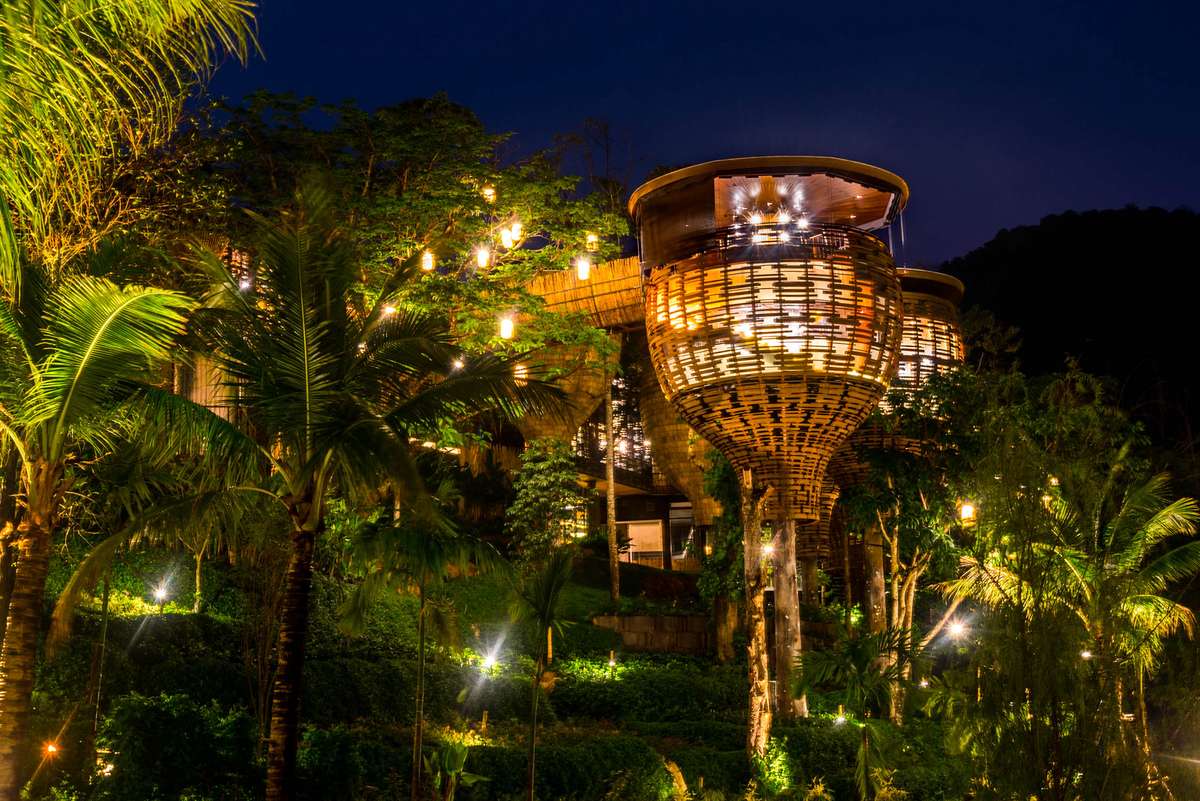
Keemala is a ten-minute drive from Patong, the loud, late-night end of Phuket in Thailand, and you would never guess it from inside. It is not a seaside resort but a rainforest retreat up a hillside, and the whole design comes out of a fable the Bangkok architecture firm invented for it: a caravan of people washed up on Phuket after a storm at sea and split into four clans — Earth, Wanderer, Sky and Nest.
The story is not decoration; it decides what you sleep in. Ground-level cottages belong to the Earth Clan, the fishermen, farmers and carpenters. Tent Villas under breezy white tarps belong to the Wanderer Clan, the traders and explorers. Higher up are the Sky Clan tree houses, teardrop-shaped rattan pods with suspended seating and a semi-circular plunge pool. At the top are the Bird’s Nest villas, woven out of a material shaped into an abstracted nest.
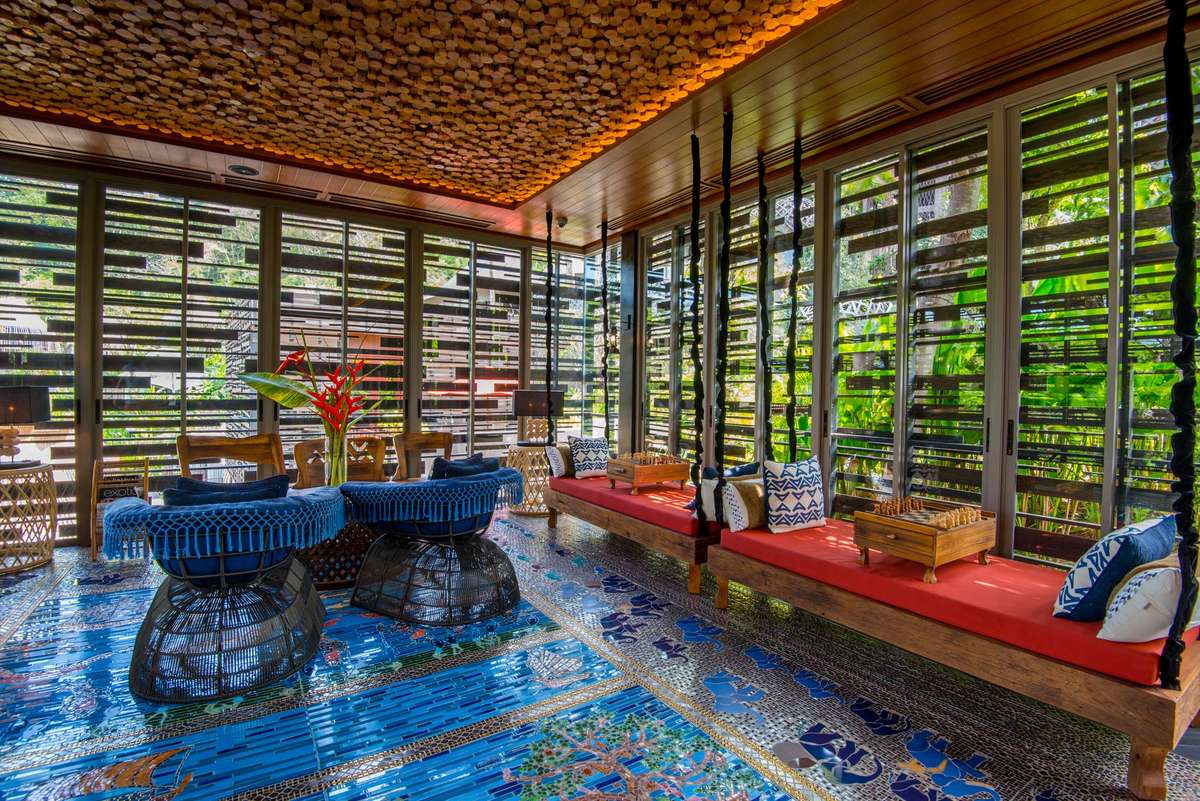
We had a Bird’s Nest: dim lighting, wood and stone, a dark palette, a carved stone bathtub and a monsoon shower on a mosaic floor. It was intimate enough that putting on makeup in the evenings was genuinely difficult, which did not bother me — no makeup and no-fuss hair should be the rule in the tropics.
Dinner has an Indian option that was some of the best Indian food we have ever had. I also took a class on mixing homemade toothpaste, which is a little too natural for me, though my teeth have never been cleaner.
The caveat from our stay: a lot of the grounds was still under construction. Otherwise this is the easiest of the seven to fit into a normal holiday — the spa is eight treatment rooms raised above the forest floor, the yoga classes are free, and an hourly shuttle runs to Kamala beach.



A private island where they take your shoes at the dock: Soneva Fushi, Maldives
You are dropped on a small dock in the middle of the Indian Ocean, and a speedboat comes for you with cold towels and fresh coconut water. Before we could step off at the other end, staff collected our shoes: the attitude at Soneva Fushi is No Shoes Needed. We were met by our Mr. Friday — your personal assistant, named after the character in Robinson Crusoe.
It occupies one of the largest private islands in the Maldives, laid out the opposite way to most resorts: villas around the edge, the interior left largely as nature made it. You drive to your villa on white sand roads through the palms and are handed a bike on arrival. Ours was a beach villa with a huge outdoor bathroom and stone tub, an outdoor loft, our own pool and our own piece of beach.
There are seven restaurants and bars, plus an ice cream parlour open round the clock that you help yourself to at any hour — gelato on a par with Italy — and a chocolate room. And then there are the rabbits, which got onto the island, did what rabbits do, and now roam free, munching lettuce and carrots and sometimes jumping into your hands.
One disappointment: ‘Fresh in the Garden’, the restaurant that sits in a treehouse, was closed while we were there. And one thing to know rather than a fault — this is a big island, so you cycle or get driven rather than walk. It suits families, or friends who want to be together and still have privacy.


How we would choose between them
If you are only doing one of these, we would send you to Awasi Patagonia. The river crossing, the guanacos on the track, the puma prints at dawn and the hot tub already heated when you get back is the widest gap between a hotel and ordinary life we have found. If you want the strangeness without the journey, take the Augustine instead: one flight to a European capital, a few minutes from Charles Bridge, and you still sleep inside a monastery from 1284.
If you are traveling with somebody who wants a holiday rather than an expedition, Keemala and Soneva Fushi both manage it while still putting you in a woven nest or on a jungle island. Temple Tree is for a week of doing nothing, and Wild Coast and Qasr Al Sarab are the two where the landscape does the work.
One thing applies to all seven. These places exist in this form because they are hard to reach and hard to run, and that shows up in your itinerary and your bill: a six-and-a-half-hour drive, a two-hour desert road, a river with no bridge, every meal on the property because there is no alternative. If that sounds like a bad trade, the problem is not the hotel. It is the category.


Find a hotel in any of these
We may earn a commission if you book through these links.